
Natural Sciences and their Technologies Question
Muitas pessoas ainda se espantam com o fato de um passageiro sair ileso de um acidente de carro enquanto o veículo onde estava teve perda total. Essas pessoas talvez considerem, equivocadamente, que os carros mais seguros são os que têm as estruturas mais rígidas, ou seja, estruturas, que durante uma colisão, apresentam menor deformação. Na verdade, o que ocorre é o contrário. Por isso, a partir de 1958, passaram a ser produzidos carros com partes que se deformam facilmente.
Assim, além dos cintos de segurança e dos airbags, os carros modernos passaram a contar com o dispositivo de segurança conhecido como crumple zone (região deformável, em inglês), conforme a figura.
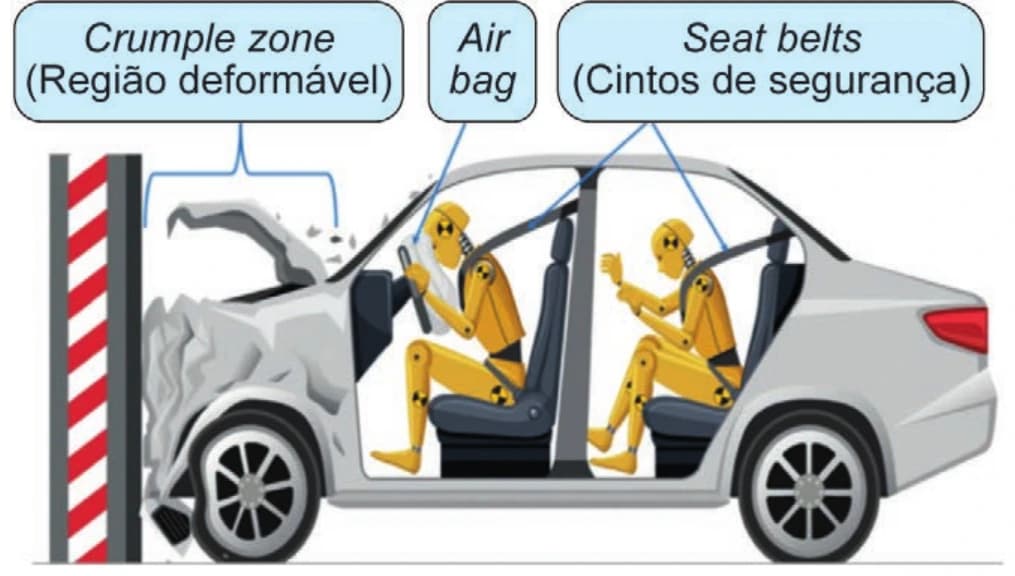
Considerando o carro, seus ocupantes e o muro da figura como um sistema isolado, o crumple zone aumenta a segurança dos passageiros porque, durante uma colisão, a deformação da estrutura do carro
It activates the vehicle's airbags.
It absorbs the kinetic energy of the system.
It consumes the momentum of the system.
It creates a protective barrier for its occupants.
decreases the speed of the center of mass of the system
Resolution & Explanations
Analysis of the "Crumple Zone" Function
The correct answer is option B) absorbs the kinetic energy of the system.
1. The Physical Principle of Collision
A collision is an event where there is a rapid transfer of energy and momentum. A moving car possesses a large amount of... kinetic energy (energy of motion). For passengers to survive a sudden stop, such as a crash, this energy needs to be dissipated safely, that is, without being transferred to the occupants.
2. The Function of the "Crumple Zone" (Deformable Region)
The "deformable region" is designed precisely to fulfill this function. The process of crushing and deforming the car's metal structure requires physical work. This work transforms the... kinetic energy converting the vehicle's energy into other forms, such as heat and sound.
- As it deforms, the front of the car absorbs the energy of the impactThis means that a significant portion of the kinetic energy the car possessed before the collision is "spent" crushing the bodywork, instead of being transferred to the passenger compartment. * Consequently, the force of the impact reaching the occupants is drastically reduced, increasing their chances of survival. The passenger cabin, on the other hand, is designed to be as rigid as possible, so as not to deform and to protect the occupants' living space.
3. Evaluation of Other Alternatives
- A) Activates the vehicle's airbags: Incorrect. Airbags are deployed by deceleration sensors, not directly by structural deformation. They are systems that work together, but one is not the cause of the other. * C) consumes the momentum of the system: Incorrect. According to the principle of conservation of momentum, the total momentum of an isolated system is not "consumed," but rather conserved or transferred. * D) It creates a protective barrier for its occupants: Incorrect, because it is inaccurate. The specific function of deformation It's not just about being a barrier, but about managing the energy of the impact. As the text points out, a more rigid barrier would be less safe. * E) decreases the velocity of the system's center of mass: Incorrect. The car's speed will go to zero anyway. The function of the crumple zone is to increase the... time which leads to this stop happening. By increasing the impact time, the force felt by the passengers decreases (according to the impulse theorem), but the main physical function of the deformation itself is the dissipation of energy.
4. Conclusion
The crumple zone increases passenger safety because, during a collision, the deformation of the car's structure... absorbs the kinetic energy of the system, converting it into other forms of energy and preventing it from being transferred to the occupants.