
Natural Sciences and their Technologies Question
Células a combustível microbianas (CCM) são capazes de gerar eletricidade a partir de águas residuárias urbanas e agroindustriais. As CCM são compostas de duas câmaras. Numa delas, onde ocorre o tratamento da matéria orgânica, as bactérias eletrogênicas crescem formando um biofilme e se alimentam dos poluentes presentes no efluente. Ao se alimentarem, essas bactérias geram uma corrente elétrica que percorre o material sobre o qual elas formaram o biofilme. Um fio condutor externo possibilita a migração dessa corrente para uma segunda câmara, promovendo uma reação química. A figura esquematiza uma CCM e as reações envolvidas.
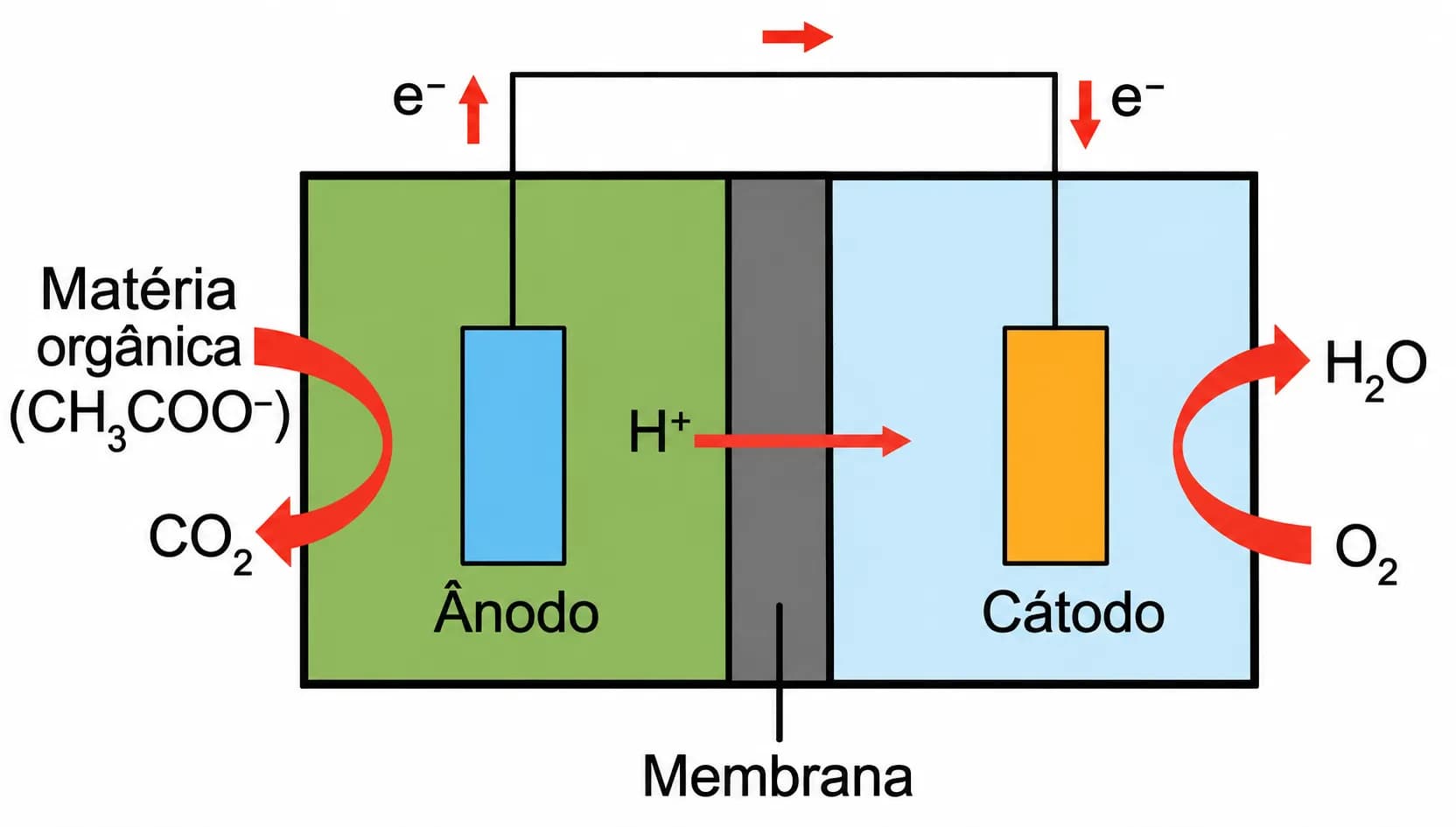
Which of the equations represents the overall reaction that occurs during the operation of this CCM?
CH3COO− (aq) + O2 (g) → 2 CO2 (g) + 3 H+ (aq)
CO2 (g) + O2 (g) + H+ (aq) → H2O (l) + CH3COO− (aq)
CH3 COO− (aq) + H+ (aq) + 2 O2 (g) → 2 CO2 (g) + 2 H2O (l)
CH3 COO− (aq) + 6 H2O (l) → 2 CO2 (g) + 2 O2 (g) + 15 H+ (aq)
2 CO2 (g) + 11 H+ (aq) + O2 (g) → CH3COO− (aq) + 4 H2O (l)
Resolution & Explanations
Microbial Fuel Cell (MFC) Analysis
The correct answer is option C) CH₃COO⁻ (aq) + H⁺ (aq) + 2 O₂ (g) → 2 CO₂ (g) + 2 H₂O (l)
1. Identification of Half-Reactions
To find the overall reaction, we need to combine the two half-reactions provided, one that occurs at the anode (oxidation) and the other at the cathode (reduction).
-
Oxidation Half-Reaction (at the Anode):
CH₃COO⁻ (aq) + 2 H₂O (l) → 2 CO₂ (g) + 7 H⁺ (aq) + 8 e⁻ -
Reduction Half-Reaction (at the Cathode):
4 H⁺ (aq) + O₂ (g) + 4 e⁻ → 2 H₂O (l)
2. Electron Balancing
The number of electrons (e⁻) released in oxidation must be equal to the number of electrons consumed in reduction.
- The oxidation reaction releases 8 electrons. * The reduction reaction consumes 4 electrons.
To equalize the number of electrons, we need to multiply the entire reduction half-reaction by 2.
2 * [4 H⁺ (aq) + O₂ (g) + 4 e⁻ → 2 H₂O (l)]* Resulting in:8 H⁺ (aq) + 2 O₂ (g) + 8 e⁻ → 4 H₂O (l)
3. Sum of Balanced Half-Reactions
Now, we add the two half-reactions (the original oxidation half-reaction and the reduction half-reaction multiplied by 2), combining all the reactants on one side and all the products on the other.
Reagents: CH₃COO⁻ (aq) + 2 H₂O (l) + 8 H⁺ (aq) + 2 O₂ (g) + 8 e⁻ Products: 2 CO₂ (g) + 7 H⁺ (aq) + 8 e⁻ + 4 H₂O (l)
The equation becomes: CH₃COO⁻ + 2 H₂O + 8 H⁺ + 2 O₂ + 8 e⁻ → 2 CO₂ + 7 H⁺ + 8 e⁻ + 4 H₂O
4. Simplifying the Global Equation
Finally, we cancel out the species that appear on both sides of the equation:
- Electrons (e⁻): We cancelled the
8 e⁻on each side. * H⁺ ions: We cancelled.7 H⁺on each side, leaving1 H⁺on the reactants side. * Water (H₂O): We cancelled.2 H₂Oon each side, leaving2 H₂Oon the product side.
The final simplified global equation is:
CH₃COO⁻ (aq) + H⁺ (aq) + 2 O₂ (g) → 2 CO₂ (g) + 2 H₂O (l)
This equation corresponds exactly to the alternative. W.