
Natural Sciences and their Technologies Question
A hidroxiapatita, Ca5(PO4)3OH, é um mineral constituinte do esmalte dos dentes. Entre as diversas reações que ocorrem no meio bucal, encontram-se em equilíbrio as reações de desmineralização e mineralização da hidroxiapatita em meio aquoso, ilustradas a seguir. A desmineralização está associada à fragilização do esmalte do dente e à formação de cáries.
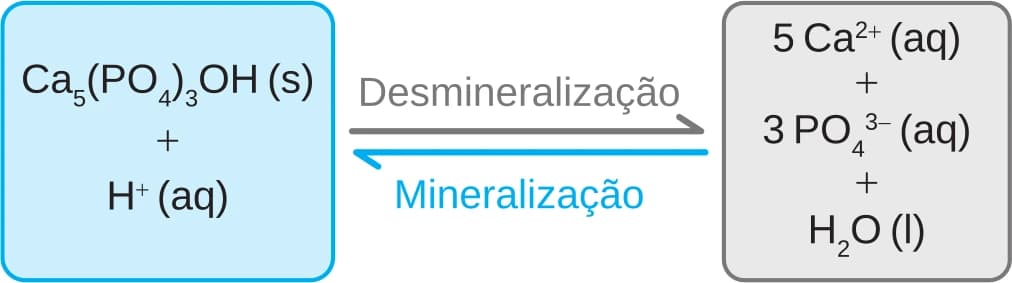
O uso de creme dental pode minimizar a perda da hidroxiapatita. O quadro apresenta o agente de polimento e o pH de alguns cremes dentais comerciais.
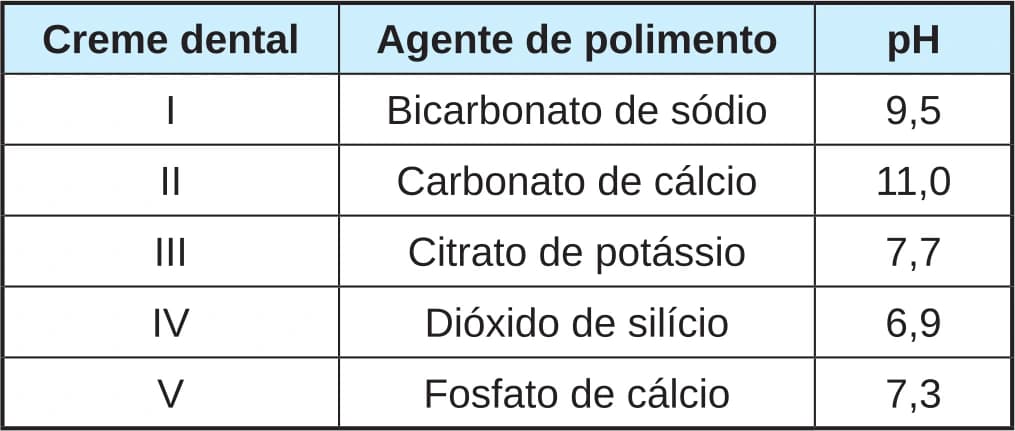
Considering the chemical balance involved, which toothpaste promotes the greatest demineralization of tooth enamel?
I
II
III
IV
V
Resolution & Explanations
Analysis of the Chemical Equilibrium of Dental Enamel
The correct answer is option D) IV.
1. Chemical Equilibrium and Le Chatelier's Principle
The issue revolves around the chemical balance of hydroxyapatite, the main component of tooth enamel:
Ca₅(PO₄)₃OH(s) + H⁺(aq) ⇌ 5 Ca²⁺(aq) + 3 PO₄³⁻(aq) + H₂O(l)
- Demineralization (→): It is a direct reaction, where solid enamel reacts with H⁺ ions (acid) and dissolves, weakening the tooth. * Mineralization (←): It is the reverse reaction, where ions in solution recombine to form solid enamel, strengthening the tooth.
THE Le Chatelier's Principle It states that if a disturbance is applied to a system in equilibrium, the system will adjust to neutralize that disturbance. In our case, the ion H⁺ it is a reagent in the demineralization process.
2. The Relationship between pH and Demineralization
- According to Le Chatelier's Principle, if **increasing the concentration of a reactant (H⁺)**The equilibrium will shift to the right to consume this excess. Shifting to the right means to promote demineralization. * The concentration of H⁺ ions is directly related to pH. One increase in H⁺ concentration This means that the environment becomes more acid, which corresponds to a decrease in pH.
Therefore, the conclusion is clear: The lower the pH, the more acidic the environment, and the greater the tendency for enamel demineralization.
3. Analysis of the Toothpaste Chart
The question asks which toothpaste promotes greater demineralizationBased on the previous conclusion, we should look for the toothpaste with the lower pH.
Analyzing the table: * Toothpaste I: pH = 9.5 (Basic) * Toothpaste II: pH = 11.0 (Basic) * Toothpaste III: pH = 7.7 (Slightly basic) * Toothpaste IV: pH = 6.9 (Slightly acidic) * Toothpaste V: pH = 7.3 (Slightly basic)
The toothpaste with the lowest pH is the IV, with a value of 6.9. Being the only one with a pH below 7.0 (neutral), it is the only one that adds H⁺ ions to the oral environment, shifting the equilibrium towards demineralization.
4. Conclusion
Considering that demineralization is intensified in an acidic environment (low pH), toothpaste IVAmong the options presented, the one with a pH of 6.9 is the most effective at weakening tooth enamel.