
Natural Sciences and their Technologies Question
Nos automóveis, é importante garantir que o centro de massa (CM) de cada conjunto roda/pneu coincida com o seu centro geométrico. Esse processo é realizado em uma máquina de balanceamento, na qual o conjunto roda e pneu é colocado para girar a uma velocidade de valor constante. Com base nas oscilações medidas, a máquina indica a posição do centro de massa do conjunto, e pequenas peças de chumbo são fixadas em lugares específicos da roda até que as vibrações diminuam. Durante o treinamento de sua equipe, a fim de corrigir a posição do centro de massa indicada pela máquina, um mecânico apresenta o esquema a seguir, com cinco possíveis pontos da roda para posicionar uma peça de chumbo.
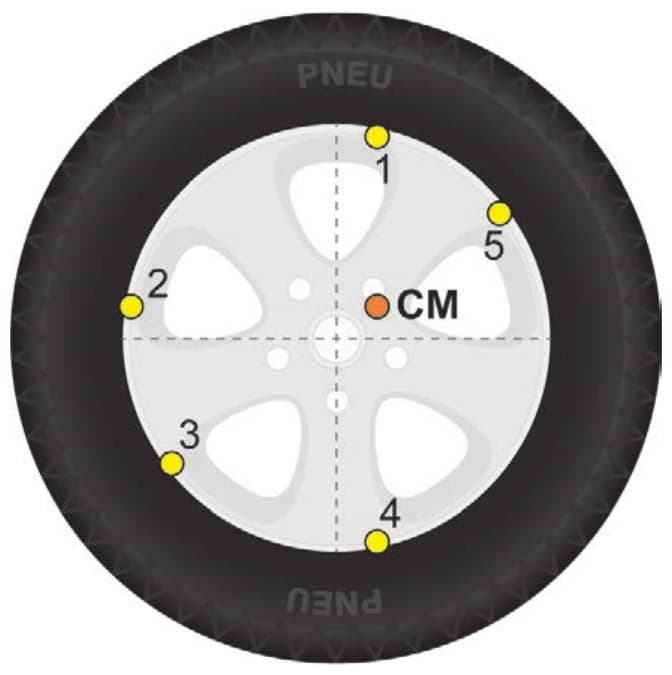
At what point should the lead piece be fixed to correct the position of the center of mass of this wheel/tire assembly?
1
2
3
4
5
Resolution & Explanations
Wheel Balancing Analysis
The correct answer is option C) 3.
1. Understanding the Problem: Center of Mass and Unbalance
- Center of Mass (CM): It is the point that represents the average position of all the mass of an object. In a perfectly symmetrical object with uniform density, such as an ideal wheel, the center of mass coincides exactly with its geometric center (the center of the axis). * Imbalance: The image shows that the Center of Mass (CM) of the wheel/tire assembly is displaced from the geometric center. This means there is an uneven distribution of mass. Specifically, there is a excess mass in the region to which the center of mass (CM) moved, which, in the case of the figure, is the upper right quadrant. * Consequence: When this wheel rotates at high speed, this excess of decentralized mass causes a resultant force that constantly changes direction, generating the vibrations and oscillations mentioned in the text.
2. The Principle of Correction: The Counterweight
The goal of balancing is to make the center of mass of the final system (wheel + tire + lead piece) coincide again with the geometric center.
To correct for excess mass on one side of a rotation axis, the solution is to add mass to that side. diametrically opposedThis additional mass will function as a counterweight, "pulling" the overall center of mass back toward the center.
3. Analysis of the Figure and Points
- Identifying the Imbalance: The center of mass (CM) is in the upper right quadrant, indicating an excess of mass in that region. 2. Determine the opposite position: The position diametrically opposite the upper right quadrant is the lower left quadrant. 3. Locate the Correction Point: Looking at the options on the wheel: * THE Point 3 It is the only one located in the lower left quadrant, exactly opposite the imbalance. * Placing a weight at Points 1 or 5 would aggravate the problem or displace it, as it would add more mass near the region that is already in excess. * Placing a weight on Points 2 or 4 would not effectively solve the problem, as they are not in directly opposite positions to counteract the imbalance.
4. Conclusion
To correct the position of the center of mass and eliminate vibrations, the lead piece must be fixed in place. point 3, which acts as a counterweight to the excess mass on the opposite side of the wheel, realigning the center of mass of the assembly with its geometric center.```